
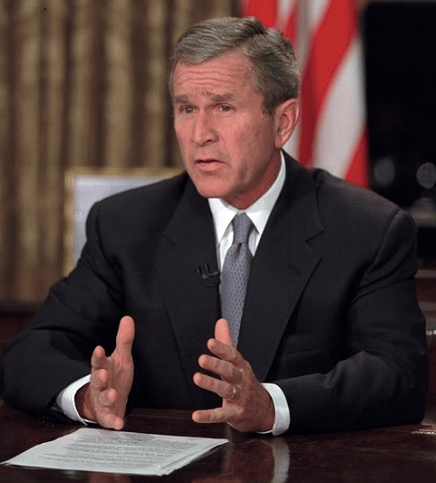
Television address to Twitter. What holds more weight?
In class on Thursday, we discussed the role of the United States’ government in counterterrorism communications. To understand how the United States creates messaging for counterterrorism, it is first important to understand how the United States first communicates about terrorism in the media. Because media in the U.S. intrinsically links religion and terrorism (when it pertains to Islam), it is also important to note how the media discusses. How did we once discuss terrorism on television? How do we now discuss terrorism on Twitter?
President Bush’s Television Addresses On and After 9/11
After the attacks on the World Trade center, president George W. Bush used television and radio to address the nation. The use of these two main media forms has been a common tactic for presidents to speak to the nation after a tragic event has occurred. The attacks on the World Trade Center happened September 11th, 2001. During this time, the age of the internet was just coming into popularity, but the majority of US citizens turned to television news to receive their information. President Bush’s address immediately following the attacks spoke of America’s braveness, addressed the feelings of anger, confusion, and fear civilians might face, and eulogized the emergency personnel who lost their lives fighting for others’. On September 17th, 2001, President Bush visited the Islamic Center in Washington D.C. and delivered a speech entitled “Islam is Peace.” This speech speaks directly against those who were quantifying all Muslim people as terrorists in the face of the associations that were occurring between Islam and terrorist extremism. He states in his speech: “Both Americans and Muslim friends and citizens, tax-paying citizens, and Muslims in nations were just appalled and could not believe what we saw on our TV screens.” His television address directly combatted television reports drawing these connections and spreading and inciting hate speech about Islam after the attacks. Pre-dating our Twitter-sphere, the television address was the main form of wide-spread direct contact between citizens and the President.
A Meditation of the Resurface of Bush’s Speech
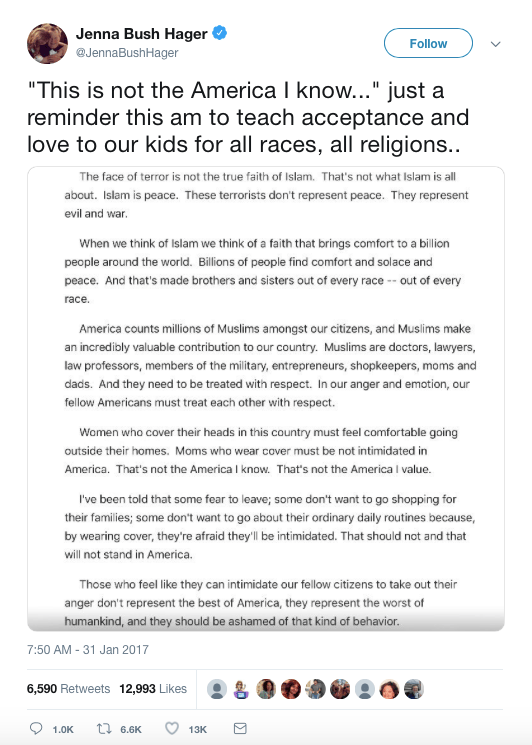
In 2017, six years after the September 11 attacks, Bush’s address from the Islamic Center in D.C. was re-circulated via Twitter. Before Twitter, a televised presidential address stood out in the clutter of the media. Since its popularization, television was an essential media tool for speaking directly to a country. Now, with the accessibility of social media, presidents have the ability to speak directly to the people much more easily and quickly. However, Twitter lacks intentionality and the idea of a presidential address as an event that occurs when during a televised press release. Twitter declarations like those Trump shared after inciting a travel ban on Syrian refugees, is more easily circulated and quicker than a Television address. Through Twitter Islamophobia becomes more integrated into media cycles. The resurface of Bush’s televised address transformed into Tweet format speaks volumes to the changing media climate and what people listen to when it comes to rhetoric about counterterrorism. This Tweet has made me wonder: How has Twitter has changed the way we speak about terrorism, counterterrorism, and hate crimes?

