In understanding the current media climate in Turkey, it is essential to look not only at the strategic economic and political choices to control media throughout Turkey, but to also understand how one uprising further contributed to the stronghold over the media and social media in Turkey. Throughout my posts I have discussed many ways in which the government censors media, but I have not yet touched on this pivotal moment in media history for Turkey. The Gezi Park Protests contributed to the continuous descent into total control over media in Turkey over the past seven years.
What were the Gezi Park Protests?
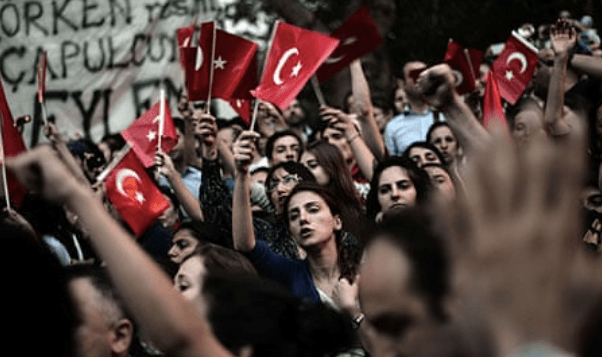
May 27, 2013, in Taksim Square, Istanbul, environmentalists gathered to peacefully protest the bulldozing and destruction of the park for capitalist development. The demonstration was broadcasted on social media, creating a public stage for the protest itself. The Turkish authorities responded by unleashing tear gas on the crowd of protesters, siting this protest as a demonstration of anti-government (a trope that is used in censorship in media as well). Brutal force was used to stop the original protest and as social media captured the police violence against civilians, more civilians joined in order to protest the government’s treatment of the original protesters.
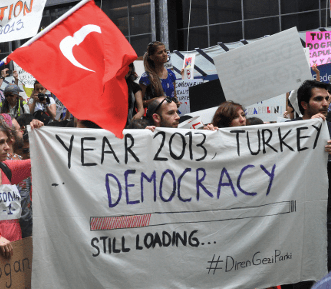
How did the media play a role in the Gezi Park Protests?
The use of social media was essential in circulating information about the Gezi Park protests. It was a photograph of a woman being attacked with pepper spray by a policeman that became the keystone of the protest and that ignited emotion and a need to resist across the country.
In the midst of the violence and police brutality, the Turkish government “condemned social media sites such as Twitter and Facebook that were being used to convey messages by protestors and their supporters.” For the Turkish government, social media became the scapegoat for the protests and was the reason the brutality occurred. Simultaneously and somewhat contradictory, social media aided the public in revealing the atrocities committed by the government.
The impact on social media:
Social media has since become a target for the Turkish government. Twitter has become a partner to authoritarian regimes. Twitter as an entity has infrastructure allows for censorship and values government officials higher than regular people, illuminating that Twitter is not egalitarian in the hands of a a regime leader. Furthermore, Turkey’s government “later made a statement that it would require Twitter to open an office in Turkey and require it to cooperate on “universal crimes” including defamation. Government made further statements regarding [unspecified] plans to introduce a law to regulate social media and require cooperation to combat ‘defamation.’”
The Gezi Park riots illuminated the power of social media in civilian uprisings. Media regulation and anti-defamation laws have fallen into place in order to further suppress any anti-state rhetoric or actions.
 Media and Politics in Turkey