
A Growing Appreciation for Documentaries
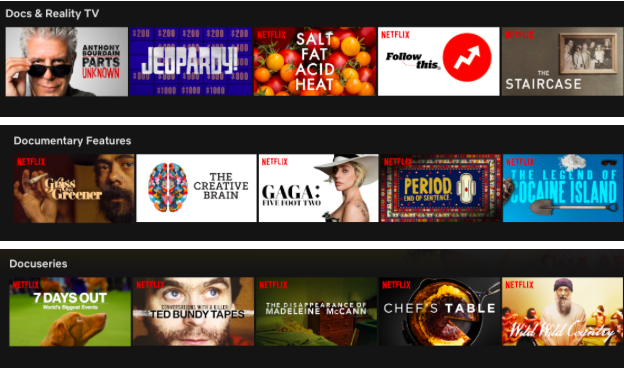
I have always loved documentaries (see my previous post about television consumption). My Netflix queue suggests “Docs & Reality TV,” “Documentaries,” and “Docu Series” based on my consistent viewing habits. Watching documentary films makes me feel as though I am uncovering something about the world in a productive manner while simultaneously being entertained. When I watch documentaries, it is one of the rare times where the TV has my full attention, unlike with sitcoms where I tend to scroll through Instagram while I watch. So while I have always had an interest in these types of films, it was not until recently, that I gained an appreciation for them.
This past summer I had the pleasure of interning at the PBS documentary company FRONTLINE, in Brighton, MA. My title was the Social Media/Audience Development intern. I spent the summer combing through the latest documentaries to pull quotes for social media graphics and find people to promote our content. Through this process I got to see a high-level documentary film at every stage and watch it undergo various edits, adjustments, and formats until it was ready for broadcasting/streaming. During the summer, I got to see the amount of hands that go into creating a 50 minute documentary. I never doubted the skills, precision, and analytical thinking required to make these films, but our final video project for Professor Webb’s class gave me a whole new appreciation for film production.
What changes would I make to my video?
Given my background in and growing understanding of social media and audience development, one change I would make to my final video is its packaging. As an 8-minute long video, our project would be more suited for YouTube or social media as opposed to a television streaming platform. For a video to do well on social media and circulate widely, it needs to be packaged distinctly. Brand recognition is essential in making clips stand out amidst the deluge of videos that are posted every day to various platforms. I watch a lot of short docu-series on Netflix and, as a result, follow many of these media companies who create Netflix content on Facebook and Twitter.
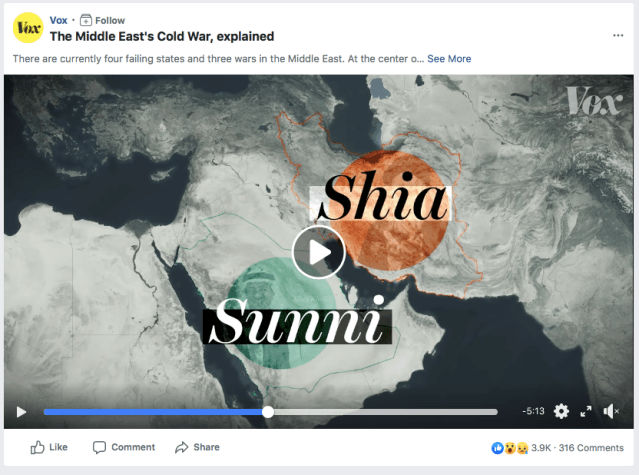
A personal favorite of mine, is the media company Vox, whose tagline is “Understand the News.” Their mission to make current events palatable makes their news and short clips highly accessible and recognizable through articles and videos that are usually under ten minutes long. Our video follows a similar format, however the graphics used for Vox’s shorts make it highly recognizable. They use distinct fonts, on-screen transitions, and coloration to make all their videos appear authentically Vox. This is not unique to this media conglomerate, Vice, CNN, BuzzFeed, and more, all use branding tactics to make their videos stand out in a feed as well as promote instantaneous brand recognition.
If I were to re-do this project, I would focus on drawing a distinct line throughout my film to make it more unique, as opposed to a patchwork of video clips that we pulled from the web. This video from Vox is one of my favorites. It explains the Cold War in the Middle East and combines various types of framework to deliver its information. It combines graphics, interviews, and clips to teach its audience about this occurrence in the Middle East. In my video, one of the most rewarding parts for me was creating my own graphics. Though at the amateur level, I used Snapz, a screen-recording application to record myself scrolling through a government document that I highlighted myself. Additionally, I created graphics where I combined a few news headlines that discussed censorship in Turkey and Morocco. This part was rewarding for me as I felt that I was not just pulling stuff from the internet, I was curating my images to fit our specific vision.
Creating a video on current events or the politics of a region, like we did, is incredibly difficult as you must balance the appropriate amount of background knowledge needed to make the video accessible. Our group balanced this well, and were also able to make the clip about 8 minutes, making it easily accessible.
Throughout this process, I’ve gained a greater appreciation for these docu-films, whether they are fifty minutes or 10 minutes long, as well as an understanding of information deliverance and what makes a clip accessible or inaccessible.
 Media and Politics in Turkey